Overengineering in Web Development: What to Avoid
Overengineering in web development adds unnecessary complexity, slows projects, and increases costs. Learn how to recognize it, avoid common mistakes, and follow simple principles for efficient, maintainable, user-focused applications.
 Babar Al-Amin

Overengineering in web development happens when developers build systems that are far more complex than actually necessary. Recent industry surveys suggest that nearly 60% of developers admit to adding unnecessary features during early project stages.
This habit often stems from good intentions, such as future-proofing applications or following popular design trends without careful evaluation. However, overengineering in web development can slow progress, increase costs, and make code harder to understand and maintain.
Instead of solving real problems, teams may spend valuable time building features that users never need or appreciate. In the article, you will learn what to avoid and how to keep your process simple and efficient. Let’s dive in.
Why Overengineering Happens in Web Development
Overengineering in web development usually comes from good intentions, not bad decisions by developers. Many teams try to build “perfect” systems, but this often leads to unnecessary complexity instead of real value.
One major reason is future-proofing. Developers design for problems that may never happen in real projects. Another common cause is unclear requirements, which push teams to cover too many possible use cases at once.
Perfectionism also plays a significant role, as developers try to build ideal solutions rather than simple working ones. In many cases, feature creep adds extra functions that users never actually need or use.
There is also a tendency to follow trends, where developers adopt tools or frameworks without real necessity. As a result, what starts as a smart idea can quickly turn into overengineering in web development.
Key Signs of Overengineered Web Applications
Overengineered web applications are harder to maintain, slower to develop, and often confusing for teams. Recognizing early warning signs can help developers simplify code, reduce unnecessary complexity, and improve overall project efficiency. Signs of overengineering include:
- Too many layers: Multiple abstractions or services for simple features make the architecture overly complex.
- Overuse of frameworks and libraries: Using heavy tools for tasks that could be solved with simple code.
- Long development time for small features: Minor changes take excessive time due to unnecessary complexity.
- Difficult-to-understand code: Requires extensive documentation or explanations for basic functions.
- Feature bloat: Extra functions that users rarely need or use.
Common Examples of Overengineering in Web Development
Overengineering often starts with good intentions but quickly adds unnecessary complexity. These practices slow development, increase costs, and create confusing code. Recognizing common examples helps developers build simpler, more maintainable applications.
Overusing Frameworks for Simple Projects
Many developers use heavy frameworks for small or static projects. This adds extra load and complexity without real benefit. Simple code or lightweight tools would often achieve the same result faster. Over-reliance on frameworks can also create dependency issues and increase maintenance time over the project’s life.
Premature Optimization
Premature optimization happens when developers try to improve performance before real traffic or data is available. Optimizing too early often unnecessarily complicates code. It can slow development and introduce bugs. Real performance problems should be solved based on actual usage, not assumptions or hypothetical scenarios.
Excessive Abstraction
Excessive abstraction occurs when too many interfaces, layers, or services are added. Simple functions become spread across multiple files or modules. This makes code harder to read and maintain. Developers may struggle to understand the logic, which increases errors and slows down updates or new feature development.
Building for Scale Too Early
Designing for millions of users from the start can overcomplicate small projects. Developers add unnecessary infrastructure and complex architecture. This consumes extra time and resources that could be better spent on essential features. Scaling should happen when traffic growth demands it, not in anticipation.
Feature Bloat
Feature bloat occurs when unnecessary features are added to impress users or stakeholders. These functions are rarely used and increase system complexity. Extra features slow development, create bugs, and confuse users. Focusing on core functionality first ensures simpler, more effective applications.
The Hidden Costs of Overengineering
Overengineering doesn’t just make code complex; it also creates real problems that hurt project success. When teams build beyond real needs, the extra effort often slows development and increases long‑term costs. These hidden costs affect both teams and business goals in ways that many people overlook.
- Slower development cycles: Unnecessary complexity slows progress, making even simple tasks take longer. Teams spend more time navigating additional layers and abstractions rather than delivering real value.
- Increased technical debt: Extra complexity often becomes technical debt that must be managed later. Over time, this makes adding new features harder and more costly.
- Harder onboarding: New developers take much longer to understand complicated systems. This slows the whole team and raises training effort.
- Higher maintenance costs: More features, layers, and dependencies require ongoing updates and bug fixes, increasing maintenance work and budget.
- Reduced agility: Overengineered systems are less adaptable to change, making it harder for teams to respond quickly to new requirements or market needs.
These costs show why avoiding unnecessary complexity is essential for efficient and sustainable web development.
Overengineering vs Good Architecture
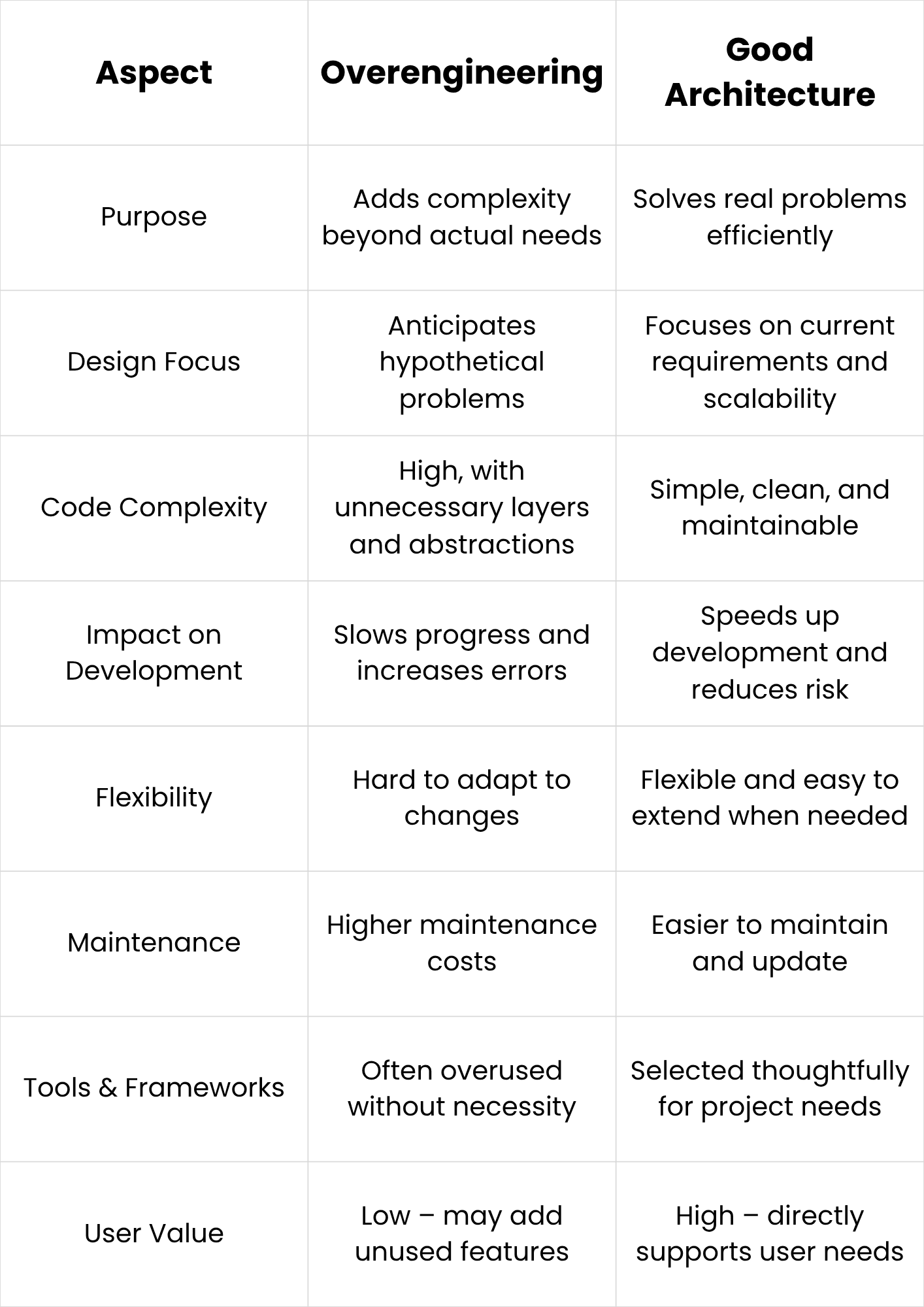
It is important to distinguish overengineering from proper software architecture. Good architecture adds structure and scalability where needed, while overengineering adds complexity without clear benefits. Understanding this difference helps developers make smarter design choices.
Good architecture focuses on solving current problems efficiently. It uses clear patterns, appropriate tools, and scalable design without adding unnecessary layers. Overengineering, by contrast, often anticipates problems that may never occur, creating extra work and potential errors.
Developers should ask whether each component or layer adds real value for users or maintainers. If it doesn’t, it may be unnecessary complexity. Balance is key: simple, maintainable code with the flexibility to scale is the hallmark of good architecture.
Following principles like KISS (Keep It Simple, Stupid) and YAGNI (You Aren’t Gonna Need It) helps maintain clarity while still allowing systems to grow when necessary. Proper architecture solves problems without overcomplicating solutions and avoids the hidden costs of overengineering.
Principles to Avoid Overengineering
Avoiding overengineering requires discipline and clear guidelines during development. Following proven principles helps teams build simpler, maintainable, and efficient web applications. These practices save time, reduce costs, and improve overall code quality.
1. Follow KISS (Keep It Simple, Stupid)
Always choose the simplest solution that works for the problem. Avoid adding extra layers, features, or abstractions. Simple solutions are easier to read, maintain, and debug. Complexity should only exist when absolutely necessary to solve real problems efficiently.
2. Build for Current Needs First
Focus on solving the actual problems users face today. Avoid designing for hypothetical scenarios or future requirements that may never happen. Start with minimal functionality, then scale the application naturally as real needs arise or traffic demands increase.
3. Use YAGNI (You Aren’t Gonna Need It)
Do not implement features before they are genuinely required. Extra functionality adds complexity, increases the chance of bugs, and creates technical debt. Only build what the project currently needs and add new features based on real user demand.
4. Choose Tools Carefully
Select frameworks, libraries, and design patterns only when they provide real, measurable benefits. Avoid using heavy tools or trends for tasks that could be solved with simple code. Thoughtful tool selection reduces dependency and long-term maintenance burden.
5. Refactor When Needed
Improve and optimize code incrementally rather than trying to make it perfect from the start. Refactoring allows the codebase to evolve naturally, removes unnecessary complexity, and keeps the application clean, maintainable, and easier to extend over time.
When Complexity Is Actually Necessary
Not all complexity in web development is bad. Some situations require advanced architecture or additional layers to meet real business or technical needs. Recognizing when complexity is justified helps teams avoid overengineering while still building robust systems.
For example, large-scale applications with millions of users need careful planning, load balancing, and efficient data handling. Security-critical systems, such as banking or healthcare apps, require additional layers of protection for sensitive information.
Performance-heavy platforms, such as real-time analytics and streaming services, also require optimized, complex architectures.
In these cases, added complexity provides real value, supports scalability, and ensures reliability. Developers should focus on building only what is truly necessary for the project’s goals.
FAQs
What is overengineering in web development?
Overengineering happens when developers make code more complex than needed. They add extra features or layers that do not help users. This makes maintenance harder and slows down development.
Why is overengineering bad?
Overengineering slows projects and makes code harder to maintain. It increases technical debt and costs. Teams spend more time on unnecessary features instead of focusing on real user needs.
How do I know if my code is overengineered?
Signs include too many layers, long times for simple tasks, unnecessary frameworks, extra features users don’t need, and code that is hard for new developers to understand.
Is using frameworks always overengineering?
No. Frameworks are useful when they solve real problems. Overengineering occurs when heavy frameworks are used without need, adding extra work and complexity for no real benefit.
How can beginners avoid overengineering?
Focus on current problems first. Keep code simple. Use KISS and YAGNI principles. Avoid unnecessary tools. Refactor code as needed. Build only what is required for users.
Conclusion
Overengineering in web development adds unnecessary complexity, slows projects, and increases maintenance costs. Developers should focus on simple, practical solutions that solve real problems.
Following principles like KISS and YAGNI helps keep code clean, flexible, and efficient. Building for current needs first and refactoring later ensures maintainable, scalable, and user-focused applications that avoid wasted time and resources.