Why Cheap Websites Cost More in the Long Run
Cheap websites may save money upfront but often lead to higher long-term costs. Poor performance, weak SEO, and limited scalability can hurt growth. Investing in a quality website ensures better user experience, visibility, and business success.
 Babar Al-Amin

Many businesses initially choose cheap websites to save money, believing a simple online presence is enough. However, research from Google shows that 53% of mobile users leave sites that take longer than 3 seconds to load.
Cheap websites often sacrifice speed, structure, and user experience, creating serious long-term performance and visibility issues. These limitations reduce search rankings, increase bounce rates, and ultimately drive potential customers toward faster, better-designed competitor websites.
Over time, businesses end up spending significantly more on redesigns, repairs, and lost opportunities than they originally saved. In this article, we will explore the hidden costs of cheap websites and why investing wisely delivers better long-term results. Let’s dive in.
Key Takeaways
- Cheap websites often lead to higher long-term costs due to poor performance, frequent fixes, and redesign needs.
- Slow loading speeds, as highlighted by Google, can drive users away and significantly reduce conversions.
- Weak SEO structure limits visibility, forcing businesses to rely more on paid marketing efforts.
- Poor user experience directly impacts trust, engagement, and overall revenue potential.
- Cheap websites create technical debt, making future updates and improvements more expensive and complex.
- Investing in a quality, scalable website delivers better ROI and supports long-term business growth.
The Illusion of Saving Money
At first glance, cheap websites appear to be a smart financial decision, especially for small businesses with limited budgets. The low upfront price creates a strong sense of savings, making it easy to overlook what is actually included—and more importantly, what is missing.
However, this initial affordability often hides a much higher total cost of ownership (TCO) over time. Cheap websites are typically built with generic templates, minimal customization, and little attention to performance or scalability. While they may work initially, these limitations quickly lead to expensive fixes, upgrades, and even complete redesigns.
In many real-world cases, businesses that invest a few hundred dollars upfront end up paying thousands later to rebuild their website properly. Some reports show low-cost websites can escalate into full redesigns costing $6,000–$10,000 within a short period due to performance and structural issues.
Ultimately, what seems like a cost-saving decision is often a false economy, where businesses pay twice—once for the cheap website and again to fix or replace it.
Hidden Costs of Cheap Websites
Cheap websites rarely fail immediately—instead, they create ongoing problems that silently drain business performance and revenue. Many of these costs are not visible up front, but they quickly become apparent as traffic drops, conversions decline, and maintenance issues increase.
1. Poor Performance and Slow Loading Speed
Cheap websites often rely on bloated templates and unoptimized code, which significantly slows down loading times. According to Google, most users abandon pages that take longer than three seconds to load.
This leads to higher bounce rates, reduced engagement, and ultimately lost revenue opportunities for businesses.
2. Weak SEO Structure
Low-cost websites often lack a solid SEO foundation, including clean code, optimized metadata, and structured internal linking. This makes it difficult for search engines like Google to crawl and rank the site effectively.
As a result, businesses struggle to gain organic traffic and depend more on paid advertising.
3. Bad User Experience (UX)
Cheap websites often feature outdated designs, poor navigation, and inconsistent layouts that confuse visitors. A frustrating user experience causes people to leave quickly and reduces trust in the brand.
Over time, this directly impacts conversions, customer retention, and overall business credibility in a competitive online marketplace.
4. Limited Scalability and Features
Many cheap websites are built on rigid templates or basic platforms that cannot easily scale as a business grows. Adding new features, integrations, or custom functionality becomes difficult and expensive.
Eventually, businesses are forced to rebuild their entire website, leading to higher long-term development costs and delays.
5. Frequent Breakdowns and Maintenance Costs
Low-quality websites often depend on outdated plugins and poorly written code, increasing the risk of technical issues. These sites require frequent fixes, updates, and troubleshooting, which can become costly over time.
Businesses may need ongoing developer support just to keep the website functioning properly and securely.
6. Security Risks
Cheap websites typically lack strong security measures, making them vulnerable to malware, hacking, and data breaches. Without proper updates and protection, sensitive business and customer information can be exposed.
Security incidents not only require costly fixes but also significantly damage brand reputation and customer trust.
7. Poor Hosting and Infrastructure
Budget websites are often hosted on low-quality servers with limited resources and reliability. This results in slow response times, frequent downtime, and inconsistent performance.
Poor hosting negatively affects user experience and search rankings, while downtime can cause missed sales opportunities and reduced customer confidence in the business.
The Biggest Hidden Cost: Lost Customers and Revenue
The most damaging consequence of a cheap website is not technical—it is the steady loss of potential customers and revenue. When a site is slow, confusing, or unreliable, visitors leave before taking any meaningful action. Research from Google shows that even small delays in load time can significantly increase bounce rates and reduce user engagement.
Every lost visitor represents a missed opportunity, whether it is a sale, inquiry, or subscription. Poor design, broken forms, or unclear calls to action can silently block conversions, even when traffic is present. Over time, these small losses compound into significant revenue gaps that businesses often fail to notice immediately.
In competitive markets, users quickly move to faster, more professional websites, choosing competitors that offer smoother experiences. This means businesses not only lose customers but also weaken their brand credibility. Ultimately, the cost of lost trust and missed conversions far exceeds the initial savings of a cheap website.
Cheap Websites Create Technical Debt
Cheap websites often introduce what developers call Technical Debt, where quick, low-cost decisions lead to expensive fixes later. These sites are usually built with shortcuts, outdated frameworks, or poorly structured code that may work initially but become problematic over time.
As updates, integrations, and new features are required, the weak foundation makes changes more complex and costly. Developers often need to spend extra time fixing underlying issues before implementing improvements, significantly increasing both time and budget requirements.
Eventually, the accumulated technical debt becomes so large that maintaining the website is no longer practical. At that point, businesses are forced into a complete rebuild, which costs far more than investing in a quality website from the beginning.
Cheap vs Quality Website: Cost Comparison
When comparing cheap and professional websites, the difference becomes clear over time rather than at launch. A low-cost website may seem affordable initially, but ongoing fixes, redesigns, and lost revenue quickly increase the total expense. In contrast, a quality website is built with long-term performance, scalability, and SEO in mind.
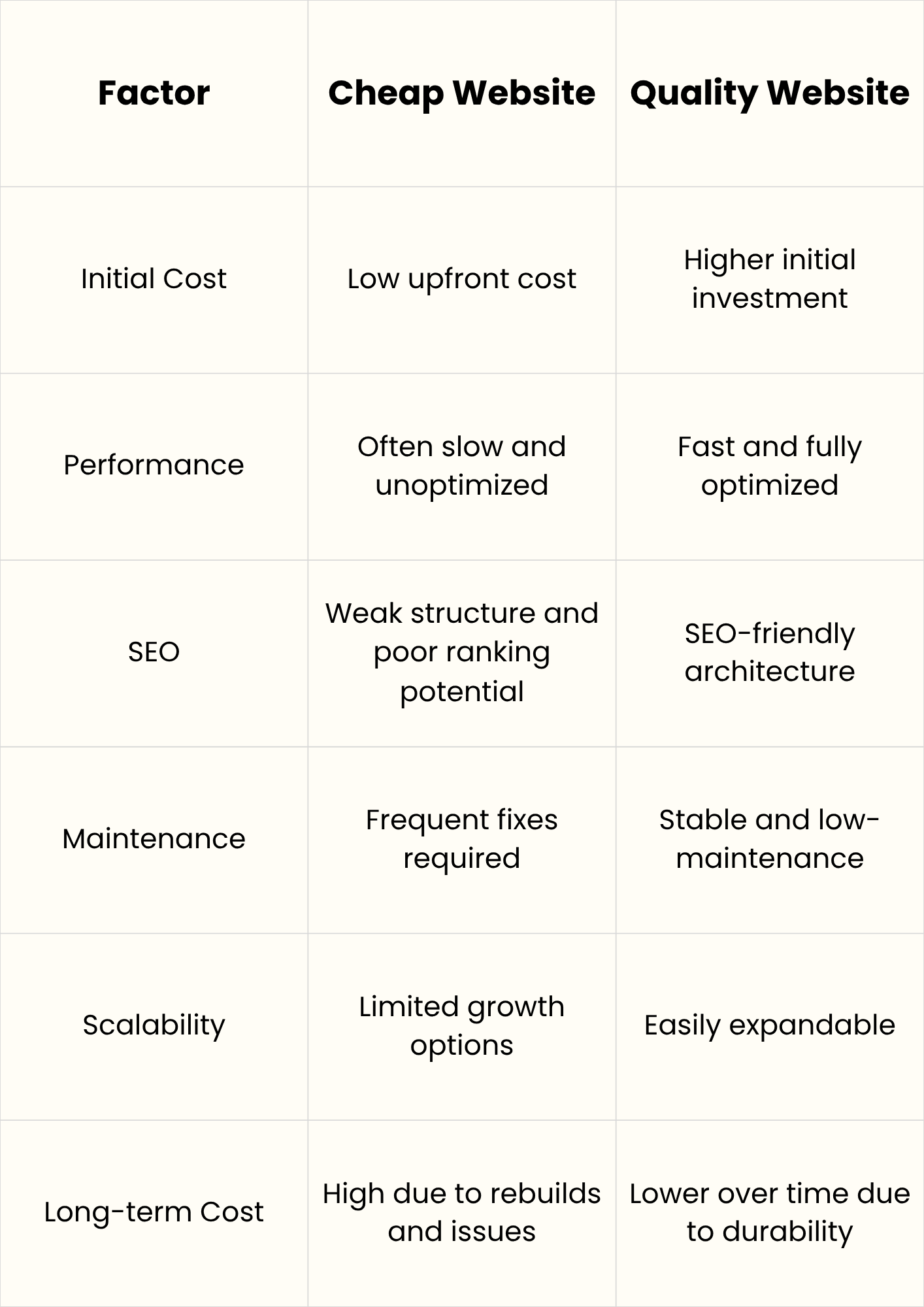
Over several years, businesses often spend significantly more fixing a cheap website than investing in a properly built one from the start. The real difference lies not in price, but in long-term return on investment and business growth potential.
When Cheap Websites Might Still Make Sense
Cheap websites are not always a bad choice, especially in specific, limited-use situations. For example, small personal projects, hobby blogs, or temporary landing pages may not require advanced performance, SEO, or scalability. In these cases, a low-cost solution can be enough to get online quickly without significant investment.
They can also be useful for testing early business ideas or minimum viable products (MVPs), where the goal is to validate an idea before committing larger resources. A basic website can help collect feedback, test demand, or run short-term campaigns.
However, even in these scenarios, it is important to understand the limitations. As soon as a business begins to grow or depend on the website for revenue, upgrading to a properly built, scalable solution becomes essential to avoid long-term costs and performance issues.
How to Avoid the “Cheap Website Trap”
Avoiding the pitfalls of a cheap website starts with thinking beyond the initial price and focusing on long-term value. A website should be treated as a business asset, not just a one-time expense. The goal is to invest in a platform that supports growth, performance, and customer trust over time.
- Ensure your website is optimized for fast loading and smooth performance, as speed directly impacts rankings and user experience on platforms like Google.
- Build your website with a strong SEO foundation, including clean code, proper structure, and clear navigation to improve visibility and reduce future optimization costs.
- Choose a scalable solution that allows you to add features, pages, and integrations easily as your business grows without needing a complete rebuild.
- Invest in reliable hosting and strong security measures to prevent downtime, protect user data, and maintain trust with your audience.
- Work with experienced developers or professionals who can create a stable, high-quality website that minimizes long-term maintenance and repair expenses.
Conclusion
Cheap websites may seem cost-effective initially, but they often lead to higher expenses through poor performance, lost customers, and constant fixes. Investing in a quality website ensures better speed, security, and scalability. As emphasized by Google, user experience matters, making a strong website a smart long-term business investment.


