Angular vs React: What are the Differences
Angular and React are leading front-end technologies, each suited for different project needs. Angular provides a full framework with strong structure and built-in tools, while React offers flexibility and fast UI updates. Compare key differences and choose the best fit for your project.
 Babar Al-Amin

Angular and React are the two most popular front-end technologies for building modern web apps. Choosing between them can affect performance, scalability, and development speed. Angular is a full-featured framework with a structured approach and built-in tools. React is a flexible UI library that relies on a strong ecosystem. In this article, we will discuss the key differences between Angular vs React. Let’s dive in.
Key Takeaways
- Angular is a full framework, while React is a UI library.
- Angular uses TypeScript by default; React uses JavaScript/JSX.
- Angular supports two-way data binding; React uses one-way data flow.
- React’s virtual DOM often delivers faster updates for dynamic UIs.
- Angular is ideal for enterprise apps; React suits fast-moving projects.
- SEO and SSR are possible in both, but require different setups.
What is Angular?
Angular is a full-featured front-end framework developed and maintained by Google. It uses TypeScript, a strongly typed version of JavaScript, which helps developers write cleaner and more maintainable code. Angular provides a complete development ecosystem, including built-in tools for routing, forms, dependency injection, and testing.
This makes it ideal for large-scale enterprise applications that require strict architecture and consistent coding standards. Its opinionated structure helps teams stay organized and scalable over time.
What is React?
React is a popular JavaScript library created by Meta (formerly Facebook) for building user interfaces. It focuses mainly on the view layer, allowing developers to create reusable UI components using JSX.
React is highly flexible and can be combined with various tools and libraries for state management, routing, and styling. Because of its lightweight core, React is ideal for fast-paced projects and startups where speed, customization, and performance are crucial.
Angular vs React: Key Differences
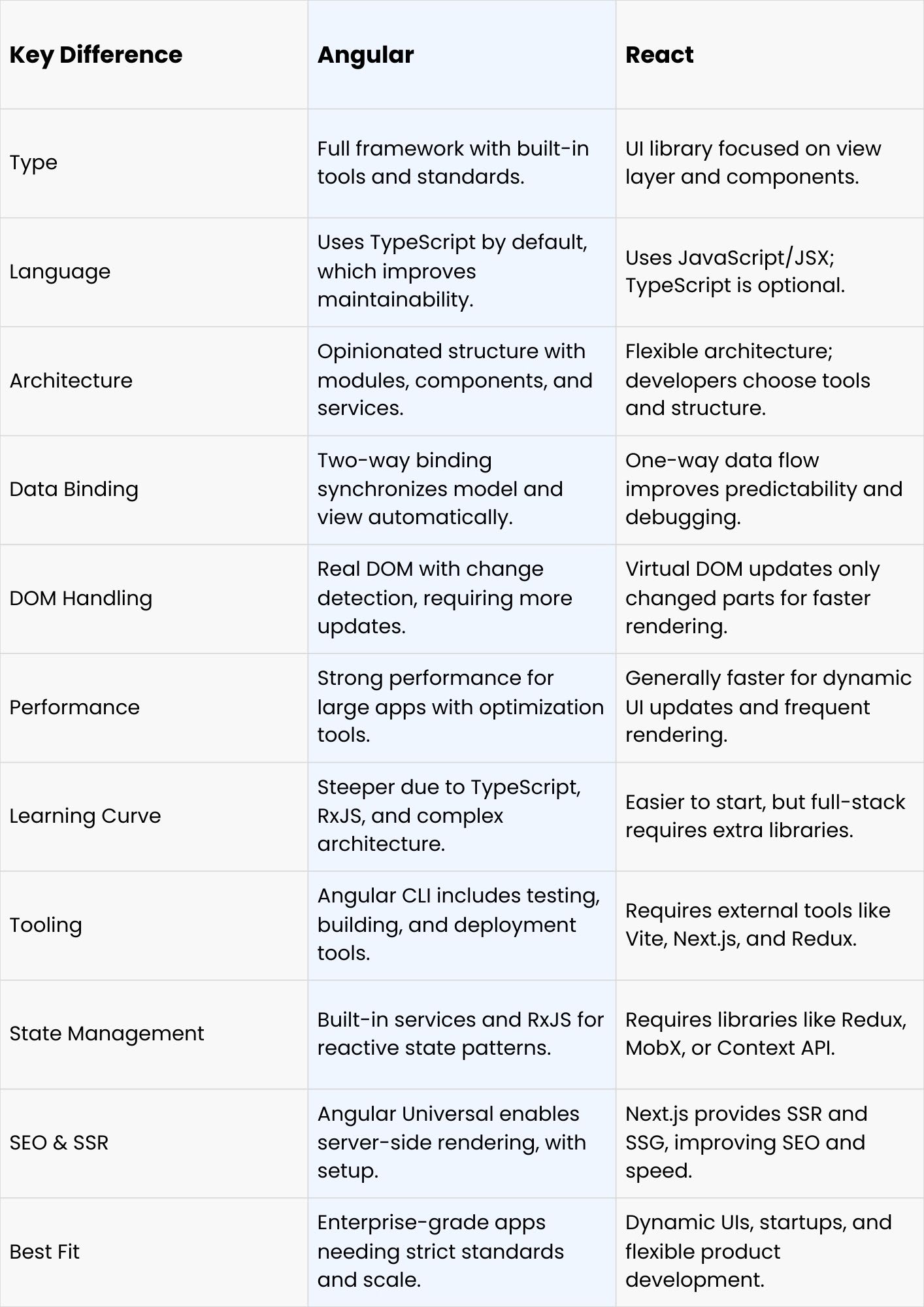
Angular and React differ fundamentally in structure, purpose, and developer workflows. Let’s take a look at the key differences:
Framework vs Library
Angular is a full-featured framework that includes built-in tools like routing, forms, and dependency injection. It provides a standardized project structure, which improves consistency in large teams.
React is a UI library focused on building components and views. It relies on third-party libraries for routing, state management, and other features. This flexibility allows custom stacks but requires more decisions during development.
Data Binding
Angular uses two-way data binding, which keeps the model and view synchronized automatically. This reduces manual updates but can increase processing overhead in complex applications.
React uses one-way data flow, where data moves from parent to child components only. This makes state changes easier to trace and debug. React’s unidirectional flow is preferred for large, dynamic interfaces with frequent updates.
DOM Handling & Performance
React uses a virtual DOM that updates only changed parts of the UI, improving rendering speed. This makes React efficient for highly interactive applications with frequent updates.
Angular uses a real DOM with change detection, which checks components for updates and can slow down rendering. Angular’s Ivy engine and AOT compilation improve performance, but React remains faster in many dynamic scenarios.
Learning Curve
Angular has a steeper learning curve due to TypeScript, RxJS, and advanced architectural patterns. Developers must learn modules, decorators, dependency injection, and Angular CLI.
React is easier to start with for JavaScript developers, focusing on components and hooks. However, building full applications requires additional libraries like Redux or React Router. Both frameworks require experience to master, but React generally feels more approachable.
SEO & Server-Side Rendering
React supports SEO effectively when paired with Next.js for server-side rendering and static generation. This setup improves load time and indexing for content-rich sites. Angular uses Angular Universal for server-side rendering, which also improves SEO but needs extra configuration. Both can achieve strong search performance, but React’s SSR tools are more widely adopted. Proper setup is crucial in either framework to maximize SEO.
Angular vs React: Use Cases
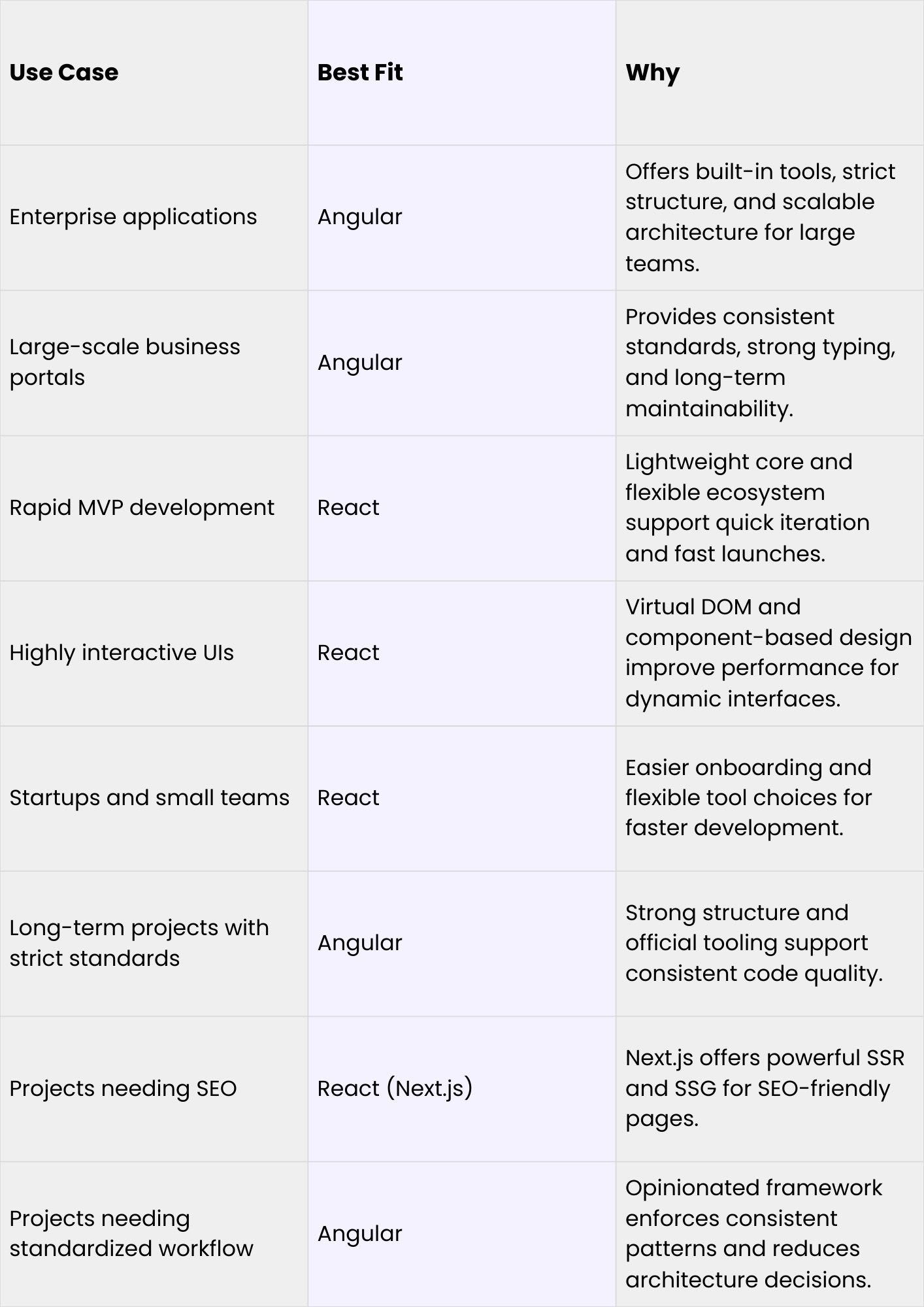
Angular suits large enterprise apps with strict architecture, while React fits fast-moving projects needing flexibility and rapid UI updates.
When to Choose Angular
Angular is ideal for large-scale enterprise applications that require strong structure and consistent coding standards, especially when teams need built-in solutions for routing, forms, and dependency injection. Its opinionated framework style helps maintain uniform code across large projects and reduces decision-making on tools. If your project requires long-term maintenance, complex business logic, and a complete development ecosystem, Angular is usually the better choice.
When to Choose React
React is best for dynamic user interfaces and projects that need rapid iteration and flexibility, especially for startups and small teams. Its component-based architecture makes building interactive UIs faster, while the ecosystem allows choosing tools for state management, routing, and styling based on your needs. If your priority is speed, performance, and a lightweight core that can adapt to changing requirements, React is the preferred option.
Angular vs React: Pros and Cons
Both Angular and React have strong advantages and trade-offs, so choosing the right one depends on your project goals, team skills, and long-term plans.
Pros of Angular
- Angular provides a complete framework with built-in tools for routing, forms, and dependency injection.
- It offers a strong structure, making large projects easier to maintain.
- Angular includes official CLI tools for testing, building, and deployment.
- It supports TypeScript by default, improving code quality and reliability.
Cons of Angular
- Angular has a steeper learning curve due to its complex architecture.
- It can feel heavy for small or simple projects.
- Development speed can be slower initially due to the framework’s structure.
- Angular apps may require more boilerplate code compared to React.
Pros of React
- React is lightweight and easy to start with for JavaScript developers.
- It uses a virtual DOM, improving rendering performance for dynamic apps.
- React has a large ecosystem with tools like Next.js and Redux.
- Its component-based architecture makes UI reuse and updates easier.
Cons of React
- React requires additional libraries for routing and state management.
- It can lead to inconsistent project structure across teams.
- Choosing the right libraries adds complexity to decision-making.
- Full-stack app development requires learning extra tools and patterns.
Which One Should You Choose?
Choosing between Angular and React depends on your project goals, team skills, and long-term plans. If you need a complete framework with built-in tools and strong structure, Angular is the better option, especially for enterprise-scale applications.
It works well when teams require consistency and a standardized development process. React is ideal for fast-moving projects and startups, where flexibility, speed, and dynamic UI performance matter most. In the end, pick the technology that fits your team’s expertise and project needs.
Want Expert Support for Your Angular or React Project?
Are you building a modern web app with Angular or React and need expert help? At WorkersLab, we build scalable web applications using the latest front-end technologies and best practices. We focus on performance, clean architecture, and long-term maintainability to keep your project efficient. Whether you need UI development, optimization, or full-stack support, we can help. Ready to move forward? Contact us today for a free consultation, and let us guide you to the best technology choice.
Conclusion
Choosing between Angular and React depends on your project needs, team skills, and long-term goals. Angular offers a complete, structured framework ideal for enterprise apps, while React provides flexibility and fast UI performance for dynamic projects. Both can deliver excellent results when used correctly. Evaluate your requirements, then pick the technology that fits your roadmap and team strengths.