Custom Software vs SaaS: Key Differences, Pros, and Cons
Comparing SaaS vs Custom Software helps businesses choose the right solution for their needs. Explore differences in cost, deployment, customization, and scalability to determine which software approach supports growth, efficiency, and long-term success.
 Babar Al-Amin

Businesses evaluating digital solutions often compare SaaS vs Custom Software to determine the best operational fit. SaaS platforms deliver ready-made, cloud-based tools through subscription models with minimal setup time. In contrast, custom software is specifically designed and developed to meet unique business requirements.
Understanding the differences between custom software vs SaaS helps organizations assess cost, scalability, control, and long-term strategic value. In this article, we will explore both models clearly to help you determine the best strategic fit. Let’s dive in.
Key Takeaways
- SaaS vs Custom Software impacts cost, deployment speed, and long-term control.
- SaaS offers quick setup, lower upfront costs, and vendor-managed maintenance.
- Custom software provides full customization, ownership, and scalability tailored to business workflows.
- The decision depends on budget, operational needs, and growth strategy.
- Understanding differences helps businesses choose the right solution for efficiency and competitive advantage.
What Is SaaS?
Software as a Service, or SaaS, delivers applications through cloud-based platforms accessed via internet browsers. Businesses subscribe to these solutions instead of purchasing software licenses or installing programs locally. Providers host, maintain, update, and secure the infrastructure, reducing users' technical responsibilities.
SaaS platforms typically offer standardized features designed to meet broad industry requirements. This model enables faster deployment, predictable costs, and scalable access without significant upfront investments.
What Is Custom Software?
Custom software is specifically designed and developed to address a company’s unique operational requirements. Unlike SaaS products, it is built from scratch to align precisely with internal workflows. Organizations maintain full control over features, integrations, data management, and security standards.
Development typically requires higher upfront investment and longer implementation timelines. However, custom software offers flexibility, competitive differentiation, and long-term adaptability aligned with evolving business strategies.
SaaS vs Custom Software: Side-by-Side Comparison
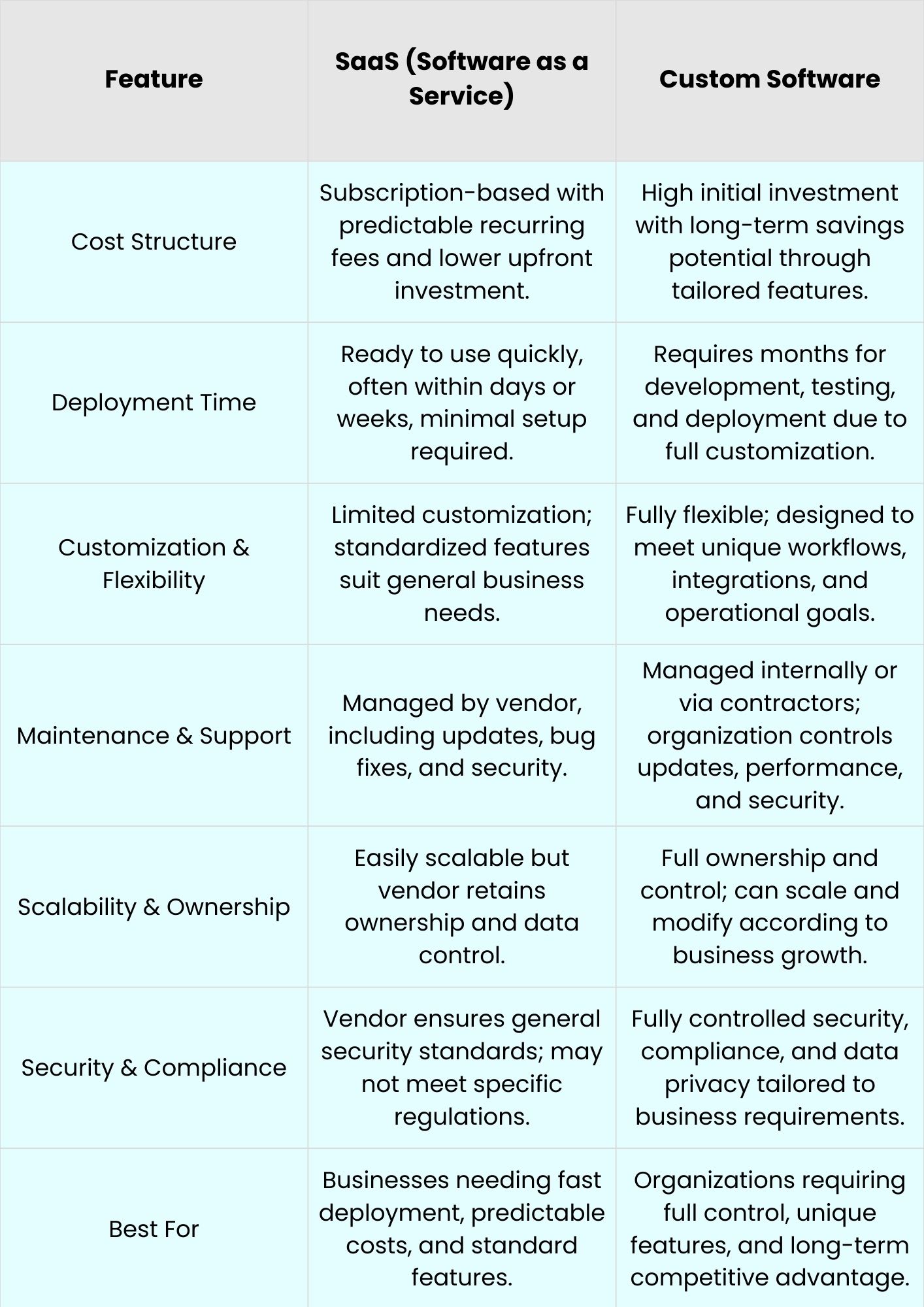
Choosing between SaaS vs Custom Software requires understanding how each approach impacts cost, deployment, control, scalability, and security. Evaluating these differences helps businesses make informed decisions and align software solutions with operational goals.
1. Cost Structure
SaaS solutions typically operate on a subscription model, charging predictable recurring fees that reduce upfront investment. Custom software requires a larger initial expenditure for development, design, and implementation.
While SaaS is often cost-effective for short-term use, custom software may save money over time by avoiding recurring subscription fees and enabling tailored features that precisely meet business requirements. Financial priorities often determine the best choice.
2. Deployment Time
SaaS platforms are cloud-based and ready to use almost immediately, minimizing setup delays. Users can access services within days or weeks, depending on configuration needs. Custom software requires design, coding, testing, and deployment, often taking months.
While slower, this process allows for tailored functionality and integration. Organizations must weigh immediate accessibility against long-term customization and specific operational requirements when deciding between SaaS and custom software.
3. Customization & Flexibility
SaaS products offer standardized features with limited customization, making them suitable for general business processes. Custom software is highly flexible, enabling businesses to create workflows, interfaces, and functionality tailored to their needs.
This adaptability ensures that internal operations, integrations, and data management align precisely with company goals. Organizations that require unique features or competitive differentiation usually benefit more from custom solutions than from off-the-shelf SaaS offerings.
4. Maintenance & Support
SaaS vendors handle maintenance, updates, and technical support, relieving businesses of day-to-day software management. Custom software requires in-house or contracted teams to manage updates, fix issues, and maintain security.
While this increases the organization's responsibility and cost, it also provides full control over functionality and performance. Companies must consider their resources and technical capacity when choosing between vendor-managed SaaS and self-maintained custom software.
5. Scalability & Ownership
SaaS platforms offer scalable access, allowing businesses to add users and features quickly, but the vendor controls ownership. Custom software provides full ownership, enabling long-term modifications and precise scaling to support business growth and future needs.
While SaaS simplifies immediate expansion, custom solutions allow organizations to retain control of data, code, and software direction, which can provide competitive advantages and reduce dependence on external providers.
Pros & Cons of SaaS and Custom Software
Understanding the real advantages and disadvantages of both SaaS and custom software helps businesses make informed decisions based on their needs, budget, and long‑term goals. Below are clearly explained benefits and limitations for each option.
Pros of SaaS
- Lower upfront costs with subscription-based pricing.
- Quick deployment; ready to use within days.
- Vendor handles updates, maintenance, and technical support.
- Scalable access for growing teams or users.
- Cloud-based, enabling remote access and team collaboration.
Cons of SaaS
- Ongoing subscription fees can add up over time.
- Limited customization; may not fit unique business workflows.
- Data security and compliance depend on the vendor.
- Less control over updates and software changes.
- Switching providers can be complex and cause vendor lock-in.
Pros of Custom Software
- Fully tailored to unique business processes and workflows.
- Complete control over features, data, and security.
- Long-term cost savings by avoiding recurring subscription fees.
- Seamless integration with existing systems.
- Highly scalable to accommodate future growth and changes.
Cons of Custom Software
- High initial investment and development costs.
- Longer development and deployment timelines.
- Requires dedicated teams for maintenance and updates.
- Risk of technology becoming outdated without regular updates.
- Smaller organizations may struggle to manage resources effectively.
When to Choose SaaS
SaaS is ideal for businesses that need fast deployment, low upfront costs, and standardized features. Startups, small businesses, or teams with limited IT resources benefit from subscription-based models and cloud access.
SaaS is suitable when your workflows are generalized and do not require heavy customization, or when teams need remote collaboration and automatic updates without managing infrastructure. This model allows quick scaling while keeping operational complexity minimal.
When to Choose Custom Software
Custom software is best for organizations with unique processes, strict security requirements, or long-term growth strategies. Enterprises, regulated industries, and companies needing full control over data, features, and integrations benefit most.
Custom solutions are appropriate when businesses want to differentiate from competitors, fully tailor workflows, or ensure compliance with specific regulations. While development takes longer, the flexibility and ownership make it a strong long-term investment.
Work With Experts Who Build the Perfect Software Solution
Are you unsure whether your business needs a SaaS solution or fully custom software to achieve its goals? Choosing the right approach can dramatically impact efficiency, scalability, and long-term growth. At WorkersLab, we specialize in custom web and software development that aligns with your business goals and workflows.
Our boutique team delivers scalable, high‑quality solutions, including SaaS platforms, web applications, and cloud systems without unnecessary complexity. We focus on practical, purpose‑driven technology that supports growth and competitive advantage. If you want software built right the first time, contact us today to share your idea and get started on your project.
Conclusion
Choosing between SaaS vs Custom Software depends on your business needs, budget, and long-term goals. SaaS offers quick deployment and lower upfront costs, while custom software provides full control, flexibility, and tailored solutions.
Evaluating these factors ensures the right fit for efficiency, growth, and competitive advantage. Make an informed decision to align technology with your business strategy.