Top 9 Backend Frameworks in 2026
Backend frameworks power server-side web development by handling routing, databases, and security. This guide compares top frameworks like Express, Django, and Laravel, helping you choose the best fit based on performance, scalability, and project needs. Learn which framework matches your goals.
 Babar Al-Amin

Backend frameworks are the foundation of modern web applications. They handle server logic, databases, and API communication behind the scenes. Choosing the right framework impacts speed, security, and scalability.
Some frameworks are lightweight and flexible, while others offer complete built-in features. In this guide, we will explore the most popular backend frameworks, their strengths, and best use cases. By the end, you’ll know which framework fits your project and skill level. Let’s dive in.
Key Takeaways
- Backend frameworks speed up server-side development and improve code structure.
- Framework choice affects performance, security, and scalability.
- Express, Django, Laravel, and Spring Boot are top options for different needs.
- Lightweight frameworks fit small projects, while full-stack frameworks suit larger systems.
- Consider team skills, project size, and future growth when choosing a framework.
What is a Backend Framework?
A backend framework is a software tool that helps developers build server-side applications faster. It provides ready-made components like routing, database access, and authentication. Instead of writing everything from scratch, developers use these tools to structure their code efficiently.
Backend frameworks manage the logic behind web apps, such as processing requests, storing data, and sending responses. In short, they simplify complex tasks and ensure the application runs smoothly and securely.
Why Use a Backend Framework?
Backend frameworks save developers time by providing pre-built features and best practices. They help organize code, making applications easier to maintain and scale. Most frameworks include built-in security tools like authentication, validation, and protection against common threats.
They also offer reliable database integration, so you can store and retrieve data efficiently. With a strong community and good documentation, backend frameworks make development faster, more consistent, and more reliable.
Key Features to Look for in a Backend Framework

A strong backend framework speeds up development, improves security, and ensures scalable architecture. Choosing the right features matters for long-term success.
Routing and API Support
Routing defines how the server responds to user requests, and API support enables data exchange between the frontend and the backend. A good framework offers easy route creation, clear URL mapping, and built-in tools for building RESTful APIs and handling JSON responses.
Database Integration & ORM
Database integration simplifies storing and retrieving data, while an ORM helps convert database tables into usable code objects. A quality framework supports popular databases and offers migration tools, query builders, and secure data access patterns for fast and consistent development.
Security Features
Security features protect your app from common attacks like SQL injection, XSS, and CSRF. Look for built-in authentication, password hashing, and input validation tools. Frameworks with strong security defaults reduce vulnerabilities and make your application safer from the start.
Scalability & Performance
Scalability ensures your app handles growing users and data without slowing down. A good framework should support caching, load balancing, and asynchronous processing. Performance tools like optimized routing and efficient database handling improve response times and user experience.
Community & Documentation Support
A strong community provides plugins, updates, and solutions for common problems. Clear documentation makes learning easier and speeds up development. Frameworks with active support are more reliable, constantly improving, and better suited for long-term projects.
Top Backend Frameworks in 2026
Here are the most popular backend frameworks in 2026:
Express.js (JavaScript)

Express.js is a lightweight, minimalistic Node.js backend framework known for speed and flexibility. It’s widely used for building REST APIs, real-time apps, and microservices. With a large ecosystem of middleware and strong community support, Express provides developers full control over routing and application structure. It pairs well with tools like Prisma or Mongoose for database work, and fits both simple and complex projects.
Key Features
- Fast and minimalist routing system
- Middleware support for custom logic
- Easy integration with databases (MongoDB, PostgreSQL)
- Ideal for RESTful APIs and microservices
Django (Python)
Django is a high-level Python framework following the “batteries-included” philosophy, offering many built-in tools. It includes an admin panel, ORM, authentication, and a middleware system by default. Django emphasizes security, scalability, and clean design principles. This makes it popular for enterprise apps, data-driven platforms, and content management systems. Its international community and extensive documentation make learning and building robust applications easier.
Key Features
- Built-in ORM for database management
- Automatic admin interface
- Strong security defaults (CSRF, XSS protection)
- Great for large, structured applications
Flask (Python)

Flask is a lightweight micro-framework for Python that prioritizes simplicity and flexibility. It provides core web server functionalities and lets developers add only the tools they need, without forcing conventions. Flask is ideal for APIs, modular applications, and small to medium-sized projects. Its minimal setup and clear design make it beginner-friendly, while its extensibility supports adding plugins, templating engines like Jinja2, and database libraries such as SQLAlchemy.
Key Features
- Simple and easy to start with
- Micro-framework with optional extensions
- Integrates well with databases and plugins
- Flexible for varied project types
Spring Boot (Java)
Spring Boot simplifies Java backend development by offering auto-configuration, starter dependencies, and embedded servers like Tomcat or Jetty. It’s designed for building enterprise-grade systems, cloud-native services, and distributed applications. Spring Boot includes monitoring via Spring Actuator and supports microservices architecture out of the box. Its rich ecosystem and tools make it ideal for large-scale systems requiring performance, modularity, and structured software patterns.
Key Features
- Auto-configuration and starter templates
- Embedded HTTP servers
- Microservices support and Spring Cloud integration
- Monitoring with Spring Actuator
Laravel (PHP)

Laravel is a modern, expressive PHP framework designed for elegant syntax and productivity. It includes built-in tools like Blade templating, Eloquent ORM for database operations, and Artisan CLI for automation. Laravel offers routing, caching, authentication, and queue management out of the box. Its developer-friendly ecosystem and clear documentation make it a strong choice for web apps, e-commerce sites, and data-intensive solutions that benefit from rapid prototyping and maintainable code.
Key Features
- Eloquent ORM for database abstraction
- Blade template engine
- Built-in tools for authentication and caching
- Artisan CLI for automation
NestJS (TypeScript/Node.js)
NestJS is a progressive Node.js framework built with TypeScript, combining scalable architecture with modern development patterns. Inspired by Angular, it uses modules, controllers, and providers to keep code organized. Nest supports both Express and Fastify as underlying HTTP layers. It integrates dependency injection, testing utilities, GraphQL, WebSockets, and microservices support, making it ideal for enterprise and large-scale projects. Its strong type safety boosts developer productivity and maintainability.
Key Features
- Modular architecture and dependency injection
- TypeScript-first design
- WebSockets, GraphQL, and microservices support
- Works with Express or Fastify
ASP.NET Core (C#)
ASP.NET Core is Microsoft’s open-source backend framework for building high-performance, cross-platform applications. It supports Windows, Linux, and macOS, and integrates tightly with tools like Visual Studio and Azure cloud services. ASP.NET Core offers advanced security features, dependency injection, and performance-optimized middleware. It’s ideal for enterprise portals, SaaS products, and API-driven systems where reliability and scalability are key priorities.
Key Features
- Cross-platform and high-performance
- Built-in security and identity systems
- Dependency injection framework
- Excellent tooling and cloud support
Fastify (Node.js)

Fastify is a modern, performance-oriented Node.js framework designed for speed and low overhead. It benchmarks significantly faster than many competitors and focuses on efficient HTTP routing and schema-based request validation. Fastify’s plugin system allows easy expansion of functionality while keeping core performance high. It’s ideal for building high-throughput APIs and microservices where low latency and scalability are essential.
Key Features
- High-performance routing engine
- Schema-based validation support
- Lightweight and extensible plugin ecosystem
- Fast API response times
Phoenix (Elixir)

Phoenix is an Elixir-based backend framework known for real-time performance, fault tolerance, and concurrency. It runs on the Erlang VM, which provides excellent support for handling many simultaneous connections. Phoenix includes features like channels for real-time communication, Pub/Sub systems, and robust fault handling. It’s perfect for chat apps, live dashboards, and systems requiring very high scalability and reliability, though its learning curve can be steeper than more mainstream frameworks.
Key Features
- High concurrency and performance
- Real-time communication support
- Fault-tolerant architecture
- Pub/Sub and live updates
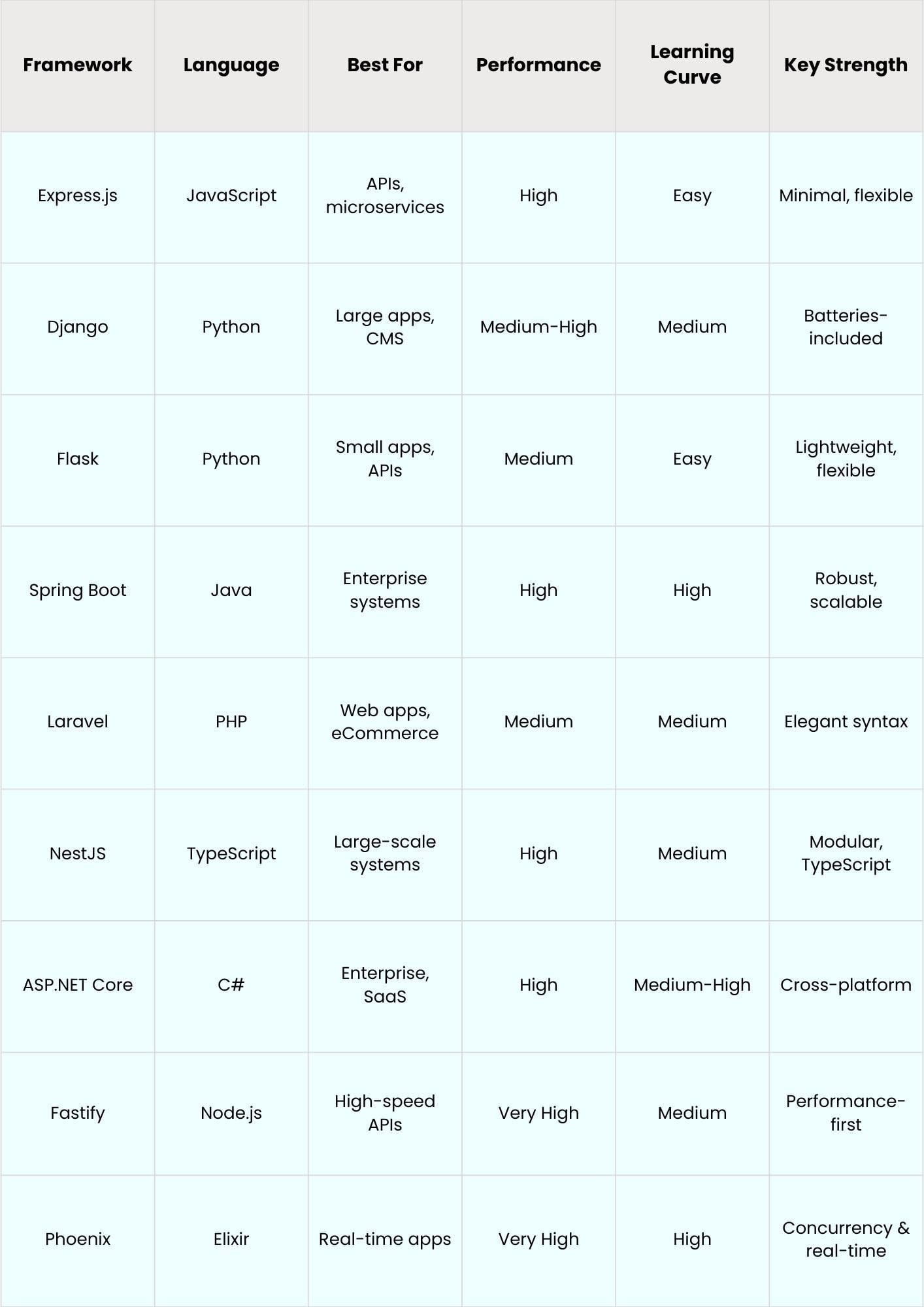
Backend Framework Comparison Table
Choosing the right backend framework depends on your project goals, team skills, and performance needs. This comparison table highlights key strengths, best use cases, and learning curves for each framework to help you decide quickly and confidently.
Want Faster Backend Development Without Sacrificing Quality?
WorkerLab helps teams build robust backend systems faster by automating repetitive tasks and improving workflow efficiency. With AI-powered automation and seamless integration capabilities, we support modern backend architectures, APIs, and custom development needs.
Whether you’re using Node.js, Python, Java, or PHP, we enhance productivity by reducing manual work and streamlining backend operations. This makes it easier to focus on clean code, scalability, and feature delivery. Contact us today and see how we can accelerate your backend projects!
Conclusion
Backend frameworks simplify server-side development, improve security, and support scalable applications. Each framework offers unique strengths, so choosing the right one depends on your project type, performance needs, and team skills. Start with a framework that matches your goals, then build your expertise over time. With the right choice, you can deliver cleaner code and faster results.